Should You Learn On1 or On2 Salsa? A Beginner’s Practical Guide

If you’re starting salsa, the short answer is: learn the timing that gives you the most good teachers and social dances where you live. On1 and On2 are both real salsa, both can be musical, and both can take you from your first basic step to advanced social dancing or performance. The difference is not “easy versus hard.” It’s more like learning two accents of the same language.
That said, the choice does matter. On1 often feels more immediately accessible because the first step lines up with the obvious “one” in the music. On2 can feel smoother and more rhythmically tucked into the percussion, but it may ask beginners to listen differently from day one. Here’s the practical guide.
Contents
What “On1” and “On2” actually mean
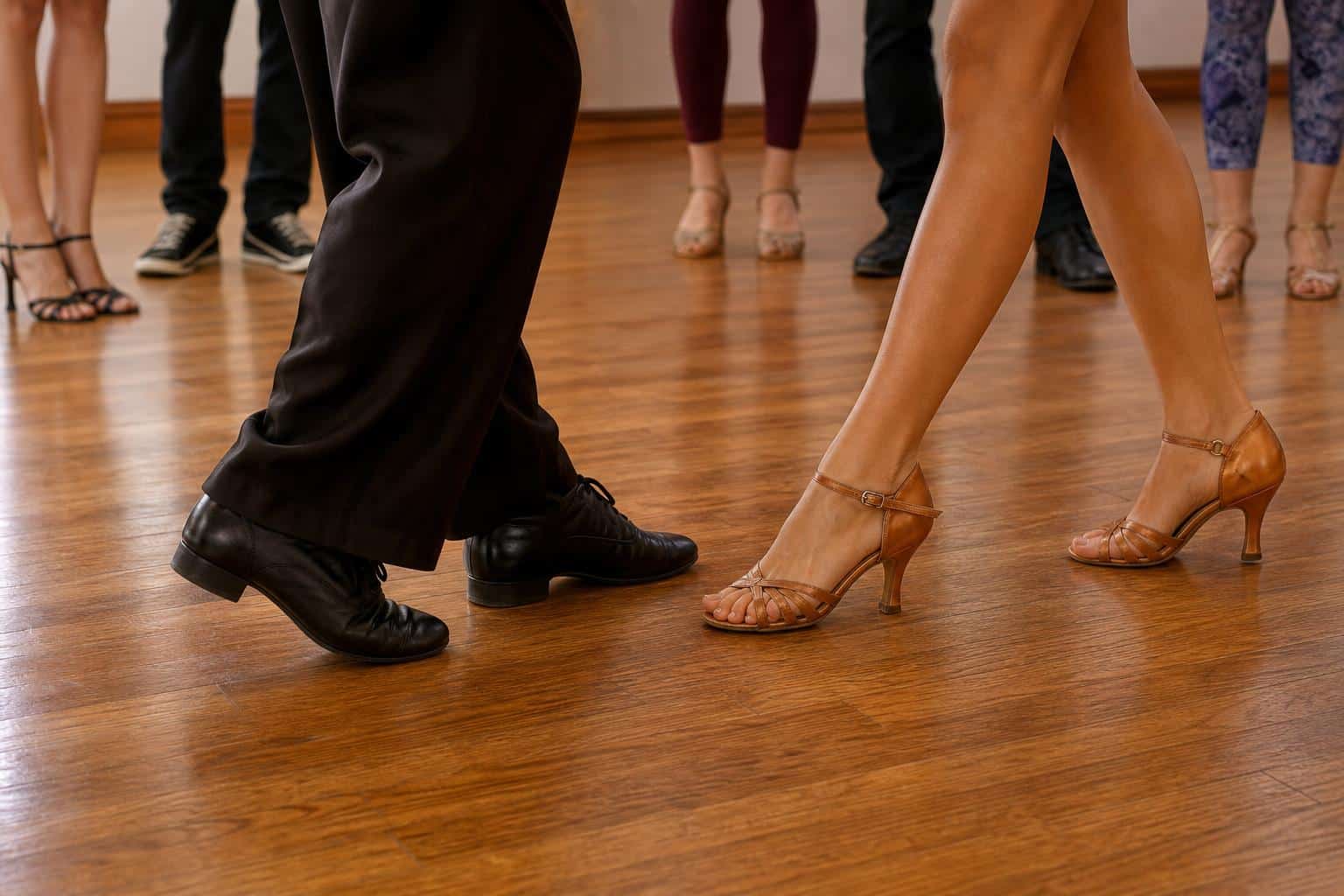
In most studio salsa, dancers step on six counts of an eight-count phrase: 1, 2, 3, then 5, 6, 7. The “on” number usually names the break step — the count where you change direction. In On1 salsa, the leader typically breaks forward on count 1 and back on count 5. In Eddie Torres-style On2, the dancer still steps on 1, 2, 3 and 5, 6, 7, but the directional change is emphasized on 2 and 6. New York-style salsa is strongly associated with On2 and with Eddie Torres, who helped formalize and spread that timing through teaching and instructional materials.
On1 is often associated with Los Angeles-style salsa: linear, flashy, athletic, and comfortable with sharp hits and showy turn patterns. Important names in the LA scene include the Vázquez brothers — Luis, Francisco, and Johnny — along with promoters and teachers who helped popularize LA-style salsa through performances, congresses, and media. This is a simplification, though: many people dance On1 without dancing “LA style,” and many social dancers mix influences freely.
A quick history and geography of the two timings
Salsa is not from one place in a tidy way. Its dance and music vocabulary draws from Cuban son, mambo, rumba, pachanga, Puerto Rican and Nuyorican culture, jazz, swing, tap, and the wider Afro-Caribbean world. New York became a crucial center for salsa music and dance in the twentieth century, especially through mambo and later salsa dura scenes. The Palladium Ballroom era is one reason “mambo” still carries prestige in On2 circles, even though modern On2 salsa is not exactly the same thing as mid-century mambo.
Geographically, On2 is especially strong in New York and in international congress scenes that admire New York mambo aesthetics. On1 is common across many parts of North America, Europe, Asia, and Latin America, partly because it is widely taught to beginners. But local reality beats general rules: some cities are overwhelmingly On1, some are proudly On2, and some have healthy scenes for both.
If you’re deciding based on where to travel for immersion, this first-hand guide to learning salsa in Colombia is a useful reality check on what daily training and social dancing can feel like. Learning to Dance Salsa in Cali, Colombia… in 60 Days
The main variants of On2 salsa
“On2” is not one single universal system. When someone says they dance On2, ask what timing they mean, because different communities use the label differently. The big practical variants are:
- Eddie Torres / New York On2: steps on 1, 2, 3 and 5, 6, 7, with the break on 2 and 6. This is what many international salsa schools mean by “mambo” or “New York style.”
- Classic mambo / Palladium / Power 2: commonly counted 2, 3, 4 and 6, 7, 8, with pauses on 1 and 5. This feels more directly “on the two” because the first weight change starts on count 2.
- Son timing / contratiempo: associated with Cuban son and often danced to 2, 3, 4 and 6, 7, 8, with attention to clave and off-beat phrasing. It is related to the On2 conversation but is not simply the same as modern linear New York salsa.
- 1, 2, 3 / 5, 6, 7 On2: this is often shorthand for Eddie Torres timing. Beginners sometimes find the name confusing because you are stepping on 1, but the break — the important change of direction — is on 2.
Is On2 harder than On1?
For a raw beginner, On1 is often easier to start. The big “one” in salsa music is usually easier to hear than the rhythmic tension around counts 2 and 6. If your teacher counts clearly and the class uses simple pop-salsa or romantica tracks, On1 can feel logical very quickly: step forward, replace, step back; step back, replace, step forward.
On2 is not inherently more advanced, though. It is harder only if your ear is not yet tuned to the percussion. A beginner who learns On2 from the start with a patient teacher may never find it strange. In fact, some dancers later find On2 more comfortable because the body movement can feel less rushed and more connected to the conga, tumbao, and clave structure of the music. Clave is a core organizing rhythm in son, mambo, salsa, and timba, and many On2 explanations connect the dance to that deeper rhythmic layer.
Is one better for performance?
Neither timing owns the stage. On1 has a reputation for big visual impact: sharp breaks, dips, tricks, fast spins, and dramatic accents. That reputation comes partly from LA-style performance culture, where the timing naturally supports hitting big musical moments on count 1. If you want crowd-pleasing choreography quickly, On1 can be a very efficient path.
On2 has a different performance personality. It often emphasizes elegance, body control, shines, syncopation, and a sophisticated relationship with the music. New York-style salsa is also known for shines — solo footwork sections where partners separate and play with rhythm — a feature often linked to the influence of jazz, tap, and New York social dance culture. For performance teams, the real question is less timing and more training style: clean basics, musical choreography, partner safety, and stage presence matter more than whether you break on 1 or 2.
Musicality: what music suits On1 or On2?
On1 often feels good with music where the downbeat is obvious and the arrangement gives you strong accents on 1 and 5: bright salsa romantica, pop-influenced salsa, and songs with clear brass hits or vocal phrasing. The dance can feel direct, energetic, and forward-driving. This does not mean On1 is unmusical; good On1 dancers can still respond to congas, bass, piano, horns, vocals, and breaks.
On2 often shines with salsa dura, mambo-influenced tracks, son-flavored music, and songs where the percussion and bass create a strong rolling groove. Dancers may listen more for the conga tumbao, the bass, the piano montuno, and the clave relationship rather than only the obvious downbeat. Son and contratiempo timing especially reward music with a strong son feel, where dancing “against” the main pulse makes the groove feel deeper rather than busier.
How to choose based on what you want to do
- For social dancing: choose the timing most people dance in your local scene. You will improve faster with more partners and more practice.
- For travel: learn to recognize both. You do not need mastery, but you should be able to survive a basic in the local timing.
- For performance: choose the team, teacher, and choreography quality first. Timing is secondary.
- For musicality: On2 may push you earlier toward percussion listening, but On1 dancers can become deeply musical too.
- For Cuban dance interests: study casino, son, and contratiempo separately rather than assuming linear On2 covers the whole Cuban world.
- For congress dancing: On2 is useful in many international mambo rooms, while On1 remains broadly practical in mixed salsa rooms.
So, should a beginner start with On1 or On2?
Either is fine. The best beginner path is the one with consistent classes, good fundamentals, friendly social opportunities, and music you actually enjoy. If your city is mostly On1, start On1 and add On2 later. If your best local teacher teaches On2, start On2 and do not worry that you are skipping a required first step. If both are available, try a month of each before deciding where to focus.
The practical rule: learn the local social language first, then become bilingual.
Eventually, strong salsa dancers benefit from understanding both timings. You do not need to switch constantly, and you should not confuse partners by changing timing mid-song unless you know what you are doing. But hearing both On1 and On2 will make you more adaptable, more musical, and more welcome in different scenes. Start somewhere. Dance a lot. Then let the music teach you the rest.