Everything I Didn’t Know About Crullers

Recently, while looking for the best donuts (doughnuts? I’ll give the Americans this one) in Melbourne — a task I was doomed to fail after deciding that the best donuts come from Cambodian refugee families in LA, in pink boxes — I discovered another fried treat vying for a precious single-digit share of my calorie budget: the cruller.
It’s hard to type “cruller” without being autocorrected, so apparently I’m not the only one who’s not privy to its mysteries. Since Melbourne has a whole cruller shop from the people behind Lune Croissanterie, I figured there must be something to them.
But I had myriad questions:
- What’s with that name? It doesn’t look French. What does it mean, how do you say it, and where’s it from?
- How are crullers different from donuts? How do you make them?
- Are they that good?
- How are French people not enormous?
Anyway, I decided to find out. Here’s everything I found, including the fact that the French have a fairly good case for asking why I’ve involved them.
Contents
Cruller: a Dutch name with a French pastry association
Merriam-Webster gives the pronunciation as “KRULL-er”, with the first vowel like the one in “cup”. Two syllables, emphasis on the first. You don’t need to attempt a French accent at the counter, unfortunately for my snobby tendencies
The English word comes from Dutch krulle, meaning a twisted cake, related to krul, “curly”. The dictionary dates its first known English use to 1801. That’s a record of the word, rather than a birthday for fried dough.
The complication is that “cruller” names more than one pastry. The older kind is a strip of dough twisted into shape and fried. Depending on where you are, the word can also mean a cake-style doughnut.
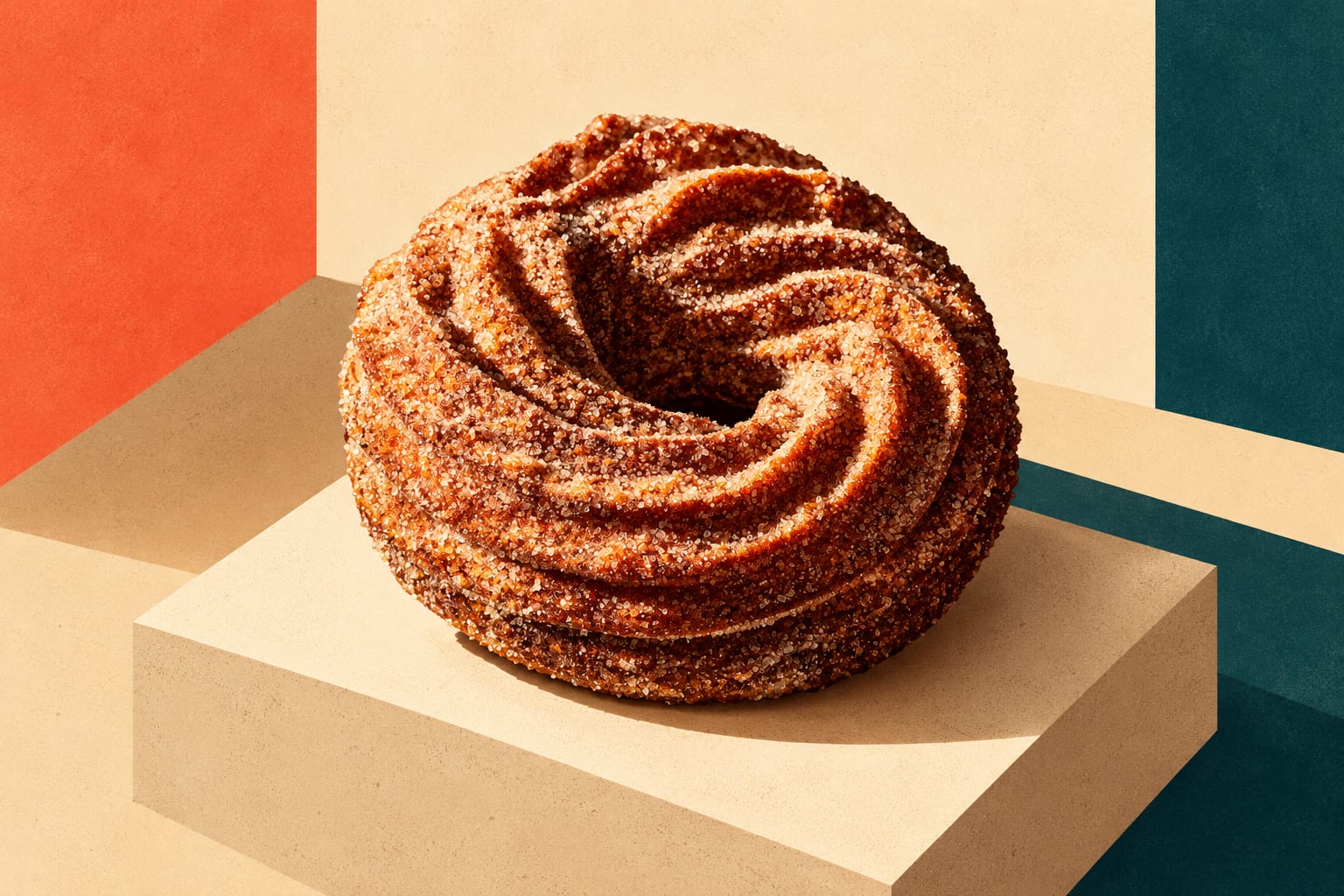
A French cruller is the fluted ring made from pâte à choux — the egg-rich pastry used for éclairs and profiteroles. Pastry writer Lara Ferroni separates the twisted cake version from the choux version in her recipe.
So the name has Dutch roots, the pastry technique is French, and the version that caught my attention comes through a Melbourne bakery’s enthusiasm for New York. Assigning it a single passport gets awkward.
How crullers differ from donuts
A French cruller is a type of doughnut. You can call it a donut without someone confiscating it. The difference is what the baker puts in the fryer:
| Type | What makes it rise | What you bite into |
|---|---|---|
| Yeast doughnut | Yeast fermentation | A soft, bread-like crumb |
| Cake doughnut | Baking powder and/or baking soda | A closer, cake-like crumb |
| French cruller | Steam expanding inside choux pastry | A crisp, ridged shell with an airy, eggy interior |
That last row explains the appeal. The cruller has much less of the bread-like middle you get in a yeast doughnut. Its ridges give you thin edges to crunch through, while the inside stays tender.
The word “custardy” comes up a lot in descriptions. I was vaguely disappointed to learn that this doesn’t mean the baker has injected custard into it. In a plain cruller, the eggs and moisture in the pastry create that impression; an actual filling is a separate option.
King Arthur Baking’s explanation of choux also cleared up something I hadn’t considered: choux isn’t the layered pastry in a croissant. A cruller doesn’t require the rolling, folding and butter layers that keep a croissant baker occupied.
How you make a cruller (and where the curls come from)
Choux starts in a saucepan, which already makes it feel suspiciously like dinner. You cook the flour with hot liquid and butter, then add the eggs once the mixture has cooled enough that they won’t scramble.
Cooking the flour changes its starches; the eggs help the pastry hold its structure. When you heat the shaped dough, its water turns to steam and inflates it. That gives you the air pockets without waiting for yeast to work.
The basic cruller process looks like this:
- Cook the paste. Bring water, butter, salt and a little sugar to the boil. Stir in flour and cook until you have a smooth, thick mass.
- Beat in the eggs. Cool the mixture, then add eggs gradually until the paste is glossy and pipeable.
- Pipe rings. Use a large star nozzle on small squares of baking paper. The nozzle makes the flutes; you don’t sit there twisting individual pastry ropes.
- Fry. Lower each ring into hot oil with its paper, then remove the paper with tongs when it releases. Turn the cruller to cook both sides.
- Drain and finish. Add glaze or toss it in sugar.
That’s an outline, rather than a complete recipe. King Arthur Baking’s French cruller recipe gives quantities, timings and an oil temperature of about 190°C (375°F). It also gives several glaze options.
The fiddly part is consistency. Runny paste won’t hold its ridges, and undercooked choux can collapse. Enough cooking time lets the structure set. This is where a bakery earns some of its money, even if the ingredient list sounds like things I already have at home.
Why Moon got my attention — and are crullers that good?
Kate and Cam Reid (of Lune) started it on Rose Street in Fitzroy in 2021. And they moved to Degraves Street in August 2026, after five years in the original shop.
Kate’s interest came from a cruller she ate at Daily Provisions in NYC. She then worked on her own recipe back in Melbourne.
The appeal of the cruller is the texture. Moon’s crullers have the trademark crunchy exterior and a soft, custardy middle. If you like the crispness of a churro and the eggy tenderness of choux pastry, that sounds like a good use of a calorie allowance (if you have that sort of thing).
If you want a chewy, bready doughnut or a heavy cream filling, a plain cruller may leave you wanting something else. More air in the middle also means less pastry to chew through, and less mass per dollar spent.
If you’re curious, I’d start with cinnamon sugar to get a clear sense of the pastry, or vanilla glaze for the glaze-and-crunch combination. Or both!
And how are French people not enormous?
Eh, this has been discussed ad nauseam. I put it down to walking more, thanks to having good public transport, and not having food that’s too laden in addictive levels of sugar and flavour enhancers. But were it not for those, I’m sure they’d be paying more of a price for so many delicious treats.