Where to Learn Persian Outside Iran

Iran has a lot to offer the traveller, or the returning Persian who wants to master their mother tongue. But current Australian Government advice is not to travel to Iran because of the volatile security situation, armed conflict, civil unrest, and the risk of arbitrary detention. So the question remains: How and where can one learn Persian outside Iran?
Iran has stunning nature, friendly and welcoming people, and an elegant, sonorous language, with beautiful script, rich poetry and thousands of years of history.
But it’s difficult for many people to go to Iran. It’s difficult for me for political and professional reasons. For others, it’s difficult for a range of reasons usually related to safety. And it may be difficult for you, too.
The good news is that Persian isn’t just spoken in Iran, and there are places you can learn Persian outside Iran.

Contents
Learn Persian/Tajik in Tajikistan
The most realistic place for in-country Persian study outside Iran is Dushanbe, the capital of Tajikistan. That doesn’t mean it’s risk-free: Australian advice is to exercise a high degree of caution in Tajikistan overall, with higher warnings for the Afghan border and parts of Gorno-Badakhshan.
The variety of Persian that people speak in Tajikistan is the closest to that spoken in Iran. The language is called Tajik, but it’s mutually intelligible. However, there are some important differences between Tajik and Persian.
Firstly, in daily life, Tajik is written in Russian Cyrillic letters. This is in contrast to Iran, where Persian has used an Arabic alphabet (technically the Perso-Arabic alphabet) for many years. The language stays the same, but the script is different.
Here’s an example of a paragraph from the Declaration of Human Rights in Tajik (Cyrillic), Persian Farsi (Perso-Arabic script), and the English translation in the Latin alphabet:
Tajik (Cyrillic)
Тамоми одамон озод ба дунё меоянд ва аз лиҳози манзилату ҳуқуқ бо ҳам баробаранд. Ҳама соҳиби ақлу виҷдонанд, бояд нисбат ба якдигар бародарвор муносабат намоянд.
Persian Farsi (Perso-Arabic)
تمام آدمان آزاد به دنیا میآیند و از لحاظ منزلت و حقوق با هم برابرند. همه صاحب عقل و وجدانند، باید نسبت به یکدیگر برادروار مناسبت نمایند.
English
All human beings are born free and equal in dignity and rights. They are endowed with reason and conscience and should act towards one another in a spirit of brotherhood.
In day-to-day life, this means Cyrillic helps enormously. But check what a course actually teaches before enrolling. The current US Critical Language Scholarship program in Dushanbe focuses primarily on Persian Farsi, with a smaller number of hours devoted to Tajiki.
There are actually some advantages to the Cyrillic script for learning Persian. It’s much easier to read for fluent English speakers (or those raised in the West) because it’s left-to-right, has some recognisable characters, and it has vowels. Vowels! What a luxury. Perso-Arabic script (like Arabic, or Hebrew) is an “abjad”, a kind of orthographic system that omits vowels. Not having vowels
Secondly, Tajik has a lot of Russian words. A lot of words have entered the vocabulary, including many day-to-day ones. This came about because of decades of Soviet rule and isolation under the USSR.
A few words that are different include:
| English | точики (Tajiki) | فارسی (Persian) |
| potato | картошка (kartoshka) | سیب زمینی (sib zamini) |
| tomato | помидор (pomidor) | گوجه فرنگی (gorjeh farangi) |
| bicycle | велосипед (velosiped) | دوچرخه (doh charkheh) |
| airplane | тайёра (tayyora)* | هواپیما (havapeima) |
| ticket | чипта (chipta) | بلیط (bilit) |
| watermelon | тарбуз (tarbuz) | هندوانه (henduneh) |
| tomorrow | Пагох (pagoh) | فردا (farda) |
* Interestingly, the Tajik word for
The majority of everyday words are the same. If you go out to buy milk, bottled water, honey and bread, you’ll do so in much the same way as you would have in Iran.
The final difference between Tajik and Persian Farsi is the accent. This is pretty significant. Speaking Persian Farsi (or Dari or Tajik) with a different accent does not in any way mean you speak it better or worse, but Tehrani and Shirazi Persian are by far the most widely understood in the region and across the Persian-speaking diaspora, simply due to economic power and the impact of media.
Some major differences between Tajik pronunciation and Tehrani are:
- The long vowel for the alef (ا) changes from aa in Tehrani Persian to a shorter o in Tajik
- The vaav (و) is more often pronounced as av in Tajik, rather than abbreviated to o in Tehrani Persian
- The general rhythm of speech is different (something best observed)
If you speak Tajik to an Iranian, they’ll understand and be fully able to communicate with you, but there’ll be an accent obstacle to overcome. It’s a bit like speaking New Zealand English to an American. It’s totally intelligible, but the American will need to focus hard to not think of scenes from Flight of the Conchords, or ask their interlocutor to say “Please miss, give me six large bits of your best ham” (something I highly recommend you do, by the way).
Otherwise, the day-to-day experience of learning Tajik in Tajikistan is different from learning Persian in Iran. When you study the language, you’ll learn a pure, literary form of the language – possibly even the same Persian spoken in Iran, by Iranian teachers.
On the streets of Dushanbe, you’ll hear local Tajiki as well as Russian and Uzbek influence. Russian remains widely used as a language of inter-ethnic communication, so people may switch to it when that makes conversation easier. This can dilute the immersion if your only goal is Iranian Persian, but it doesn’t stop Dushanbe from being a strong place to study.
Tajik is the state language and Russian has a formal role as a language of inter-ethnic communication. In practice, how much Russian you hear depends on the person, neighbourhood, and setting.
If you’re hell-bent on learning Tajik — or Persian Farsi, in Tajikistan — your best bet is a school.
The American Councils Dushanbe Language Center remains active. It hosted the US State Department’s 2026 Critical Language Scholarship Persian program, with instruction from beginner through advanced levels. The formal classes focus mainly on Persian Farsi, while Tajiki is taught for local communication.
I couldn’t find public, self-funded tuition for the Dushanbe Language Center, so I’ve removed the old semester and summer figures. Ask the center or program organiser for a current quote rather than budgeting from numbers quoted in an earlier version of this article.
For eligible Americans, the Critical Language Scholarship is the clearest route. It’s a funded, intensive summer program, but eligibility is narrow: applicants must be US citizens or nationals and enrolled in an accredited US degree-granting program during the relevant application cycle.
Entry rules depend on your passport. Australians can currently enter Tajikistan without a visa for up to 30 days, but need a visa for longer stays. Stays longer than 10 days must be registered with OVIR, and Gorno-Badakhshan requires a separate permit. Check the current official requirements before booking because they can change at short notice.
Learn Persian/Dari in Afghanistan
Afghanistan is an obvious place to encounter Dari, the local form of Persian, but it isn’t currently a responsible study destination. The language is officially called Dari, while many everyday speakers call it “Farsi”.
The current advice is unambiguous. The Australian Government says not to travel anywhere in Afghanistan because of terrorism, kidnapping, arbitrary detention, and armed conflict. That applies to everyone, including dual nationals.
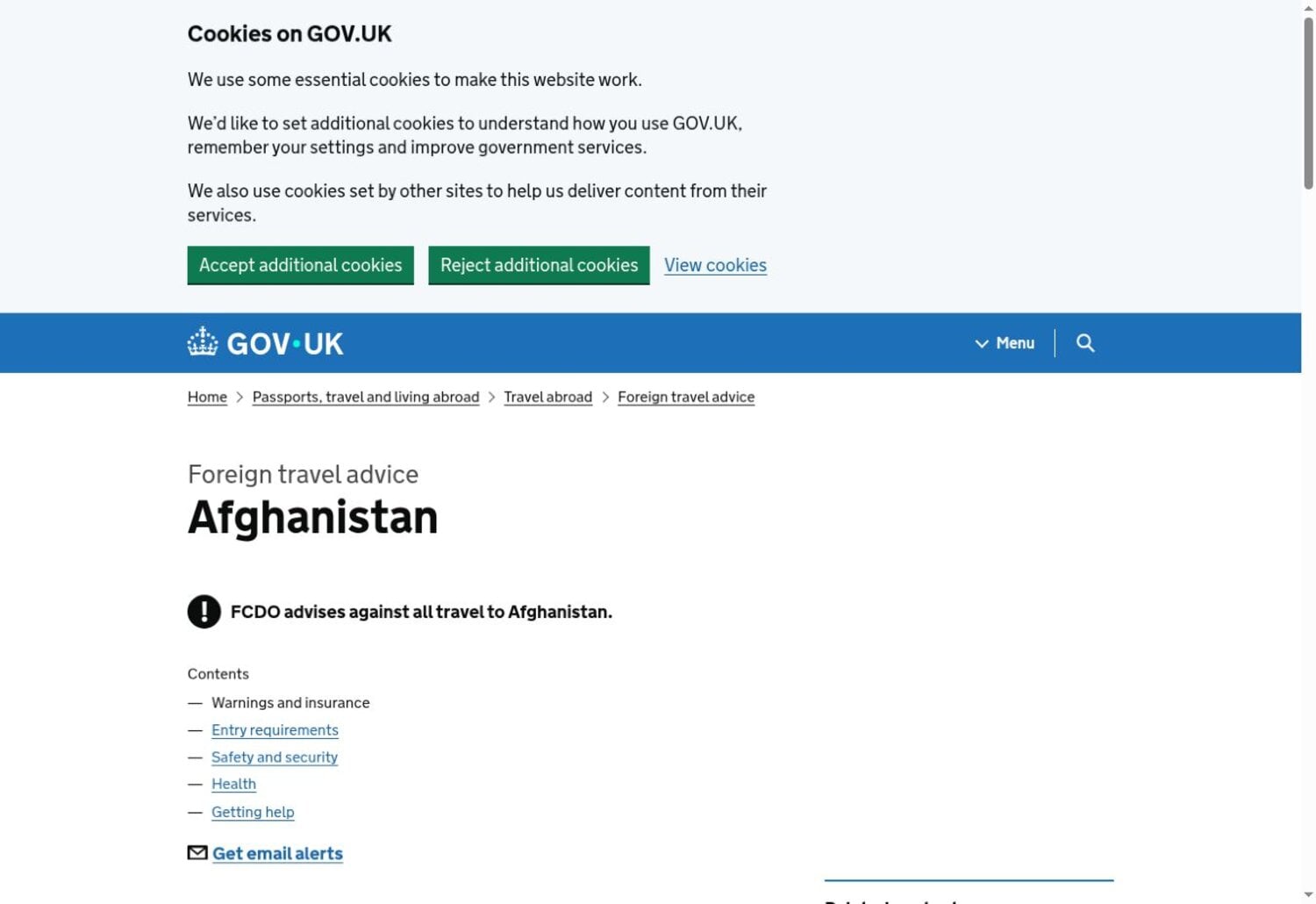
This should stop you from treating Afghanistan as a language-study destination. The advice specifically says nowhere in the country is safe, including Kabul. Learn Dari online or with Afghan speakers in the diaspora instead.
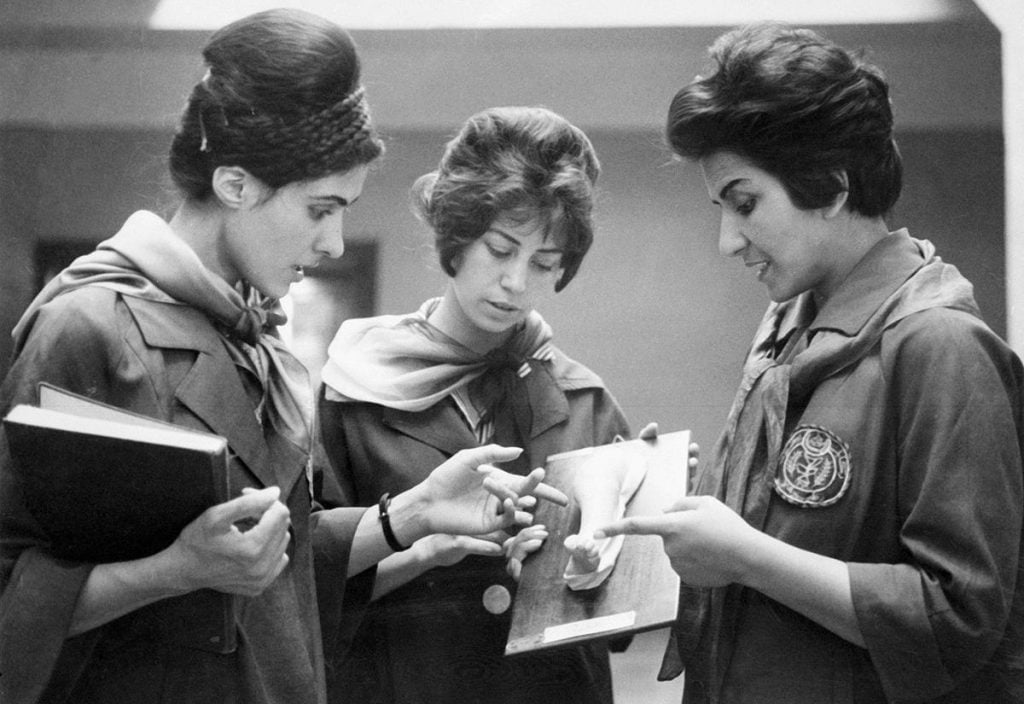
The two main languages of Afghanistan are Dari and Pashto. Both belong to the broader Indo-Iranian language family, but, like French and Italian, they aren’t mutually intelligible.
Dari and Pashto are Afghanistan’s two official languages. CLEAR Global’s language data estimates that Dari is spoken by about 77% of the population and Pashto by about 48%; the totals overlap because many Afghans are multilingual. Dari remains the main lingua franca across many ethnic groups.
Pashto is the language of many Pashtuns, who have a strong cultural connection with it. Even if your goal is Dari, learning a dozen everyday Pashto words can still go a long way.
Persian in Afghanistan is written in Perso-Arabic script, just like in Iran. So the differences are reduced to accent and everyday vocabulary.
The most prominent difference between Persian in Afghanistan and Tehran/Shiraz is the pronunciation.
Again, just as I mentioned with Tajiki, there is no “correct” accent of Persian, but the Tehrani/Shirazi accents are the ones most widely understood, just because of the economic and cultural influence of those regions.
Some of the differences in pronunciation between Persian spoken in Afghanistan and Tehran/Shiraz are:
- The letter qaff (ق): Afghans pronounce this similar to Arabic, whereas in most of Iran it’s pronounced as they pronounce the letter ghayn (غ), like a French r as in rouge.
- Preservation of the short a and long aa vowels: In Tehrani and Shirazi Persian, a long aa (alef, ا) is pronounced with a u, and a short a (not written) is often changed to an e. For example, to say “I don’t know” in Persian (نمی دانم), a Tehrani/Shirazi would say “nemidoonam”, whereas an Afghan would say “namidaanam”.
- The letter waaw/vaav (و): In Afghan Persian / Dari the vaav consonant is pronounced as a w sound, as in Arabic, whereas in Iran it is more commonly pronounced as a v sound.
The second difference between Persian in Afghanistan and Iran is some everyday vocabulary. These are much more subtle than between Tajik and other forms of Persian, and are akin to slang/colloquial differences between British and American English.
For example, the expression “غلط کردی” (ghalat kardi), translates literally to “you did a mistake”. When said by an Afghan it literally means this: “it appears you made an error”. In Persian Farsi, however, it is very accusative, and means “How dare you!” This is just one common example.
Learn Persian Online (At Home)
Under present travel advice, Iran and Afghanistan aren’t sensible language-study destinations. Tajikistan is the remaining immersion option in the region, subject to your government’s current advice and your own circumstances. Otherwise, the most practical route is to study online or find a Persian teacher in your home country.
For me, as a “heritage” Persian speaker, this means going to my parents and asking them to humbly teach me to get to the next level. Of course, I’ll be arming myself with books and learning resources to make sure I can make the best use of their time.
See here for more ideas about learning a heritage language.
Another option is to get a teacher on italki. Prices vary by tutor and lesson length, so compare current profiles and book a trial lesson. Make sure the teacher offers the variety you want: Iranian Persian, Dari, or Tajiki.
Our personal advice: Don’t travel to Iran or Afghanistan against current government advice just to study Persian. Consider Tajikistan only after checking the latest warnings and entry rules. For most people, an online teacher and regular contact with Persian-speaking family, friends, or local communities is the simpler choice.
Why Learn Persian?
It isn’t one of the world’s biggest languages, and may not have an obvious practical payoff unless you have Persian family or plan to spend time in a Persian-speaking community.
So the best reason, in my belief, to learn Persian and Persian culture is to bridge cultural gaps between the West and a misunderstood and under-appreciated part of the world.
Many in the West don’t know much about of Iran and Persian people, conflating the two things. It’s true that the government of Iran acts unpredictably and is often in the spotlight for it.
Current travel advice cites armed conflict, civil unrest, and arbitrary detention, including the detention of foreign and dual nationals. These are reasons to take the warnings seriously, not reasons to confuse the Iranian government with Persian people.
But Persians are not the same as the Iranian government. This is no surprise to you if you know any Persians any of the other major metropolises of the world (there is a large Persian diaspora).
Persians are a gentle, philosophical, quiet people, whose culture is historically a blend of traditional Persian culture dating back thousands of years, with regional influence from the Indian subcontinent and the Arab states.
Many of my friends and teachers inside and outside Iran don’t identify with the religious authorities or their actions. I can’t turn those conversations into a reliable national percentage, but the broader point stands: a government doesn’t represent every person it governs.
But more immediately, you can relate to Persians just like you can relate to most people: They’re mostly a generation or two out of poverty and so remember hardship, value things like family success of their children, and enjoy eating lamb, and rice with lots of stuff in it.

Why Some People Can’t Travel to Iran to Learn Persian
There are various reasons for which people can’t travel to Iran which are worth mentioning. That’s the genesis of this blog post.
For example, people of Bahá’í background in Iran have faced systematic persecution, imprisonment, torture, and other serious abuses. People from other religious and ethnic minorities have also been targeted.
(Editor’s note: I was raised in the Bahá’í religion. While I’m not a Bahá’í myself, and have long distanced myself from any religion, I’ve still been subject to persecution from Iran for my ties to Bahá’ís.)
Secondly, people from countries with no formal relations with Iran. This includes states not recognised by Iran, but also the USA.
Visa rules are nationality-specific and can change quickly. British official guidance currently says British passport holders must apply as part of an organised tour or have a sponsor in Iran, and warns that the process can be long and unpredictable. US citizens face their own restrictions and have no US embassy or routine consular assistance in Iran. Don’t rely on the old 60–90 day estimate in an earlier version of this article.
Third, people with Iranian nationality or a claim to it. Iran doesn’t recognise dual nationality. Australian official advice says Iranian dual nationals must enter and leave on an Iranian passport and may receive extremely limited Australian consular help. Iranian authorities may also regard some people as Iranian even if they don’t consider themselves Iranian.
Finally, people of some professions, such as journalists or researchers. There have been many cases of detention of people suspected of spying.
Don’t assume you can get a visa on arrival. Australian official advice currently says Australians need a visa before travel, while British rules differ again. Check with the nearest Iranian embassy for the rules applying to your exact passport, and remember that having a visa doesn’t remove the security and detention risks.